Hello. I am in the group that is working on the recipe portion of the Health book and would like to share my ideas with the class. Our groups wants to pick specific ingredients that help fight against cancer and fight breakfast, lunch, and dinner recipes that incorporate that particular ingredient. From the comments on the last post, it seemed like adding a small sub-section with recipes for people already diagnosed with cancer was practical. Do you guys have other suggestions that you would like to see us include?
Also, I have recently explored the cookbook section at a Barnes and Noble and I came across a book that I really liked. It is called "The Anti-Cancer Cookbook" by Dr. Julia Greer. I searched online and found the recipes for free on Dr. Oz's website!
Thursday, March 10, 2011

Sunday, March 6, 2011
Food Safety for People with Cancer
Hello Everyone,
I came across this PDF which I felt would be of interest to the group working on the recipe section of the heatly guide. This mainly pretains to those already diagnosed with cancer and the article addresses the need for patients undergoing chemotherapy to be mindful of what they eat and how they prepare it. Chemotherapy weakens the body's immune system and makes the individual more susceptible to infections especially those brought on by foodborne illness. I'm not sure if you guys are only adding recipes to fight cancer or if you are also including recipes for those diagnosed with cancer, but it would be great if you could incorporate some of the information from this PDF.
I came across this PDF which I felt would be of interest to the group working on the recipe section of the heatly guide. This mainly pretains to those already diagnosed with cancer and the article addresses the need for patients undergoing chemotherapy to be mindful of what they eat and how they prepare it. Chemotherapy weakens the body's immune system and makes the individual more susceptible to infections especially those brought on by foodborne illness. I'm not sure if you guys are only adding recipes to fight cancer or if you are also including recipes for those diagnosed with cancer, but it would be great if you could incorporate some of the information from this PDF.
Friday, March 4, 2011
Food Ingredients and Colors
Hello,
In this article the FDA answers the question of what are food and color additives which leads to them discussing the main roles they play in our food. They begin the article by stating that the purpose of them writing about these products is that consumers worry about the long & complicated names of food products that are found on food labels. The FDA goes on to say, that even in simple foods, such as strawberry's, there are complicated compounds that give the aforementioned strawberry its color and flavor.
Food additives are any substance that are added to food that may directly or indirectly change the characteristics of food.
Color additives are any dye, pigment or substance that when applied to foods, drugs, or cosmetics add a color to the substance.
Some reasons the FDA give for adding these food and color additives are:
- To maintain/improve freshness and safety- these additives prevent the food from early spoiling and prevent harmful bacteria/mold from growing on these foods.
- To improve/maintain nutritional value- they use vitamins and minerals(fiber) to fortify and enhance food products that may have lost their nutritional value during processing. This process has reduce malnutrition in the U.S. and throughout the world.
- Improve taste, texture and appearance- the taste of foods are enhanced by spices, natural/artificial flavors, and sweeteners. Emulsifiers, stabilizers, and thickeners gives food their texture (pudding is and example).
All about Food Labels
Hello,
I found this article which goes into detail about how to properly read a food label. There is even a chart that goes into how to interpret "FDA lingo" such as 'fat-free', 'less fat', 'lean', 'high-fiber' and others.
From my standpoint, I had believed that I understood how food labels were to be read and interpreted and what each item had on my overall health status. I feel that by enabling the Harlem community (both children and adults) we can lower the incidence and prevalence rates of food associated illnesses.
Here are some interesting facts that I learned by reading the article.
- In 1990 the Nutrition Labeling and Education Act went into effect and required that the common name of the product, net content in terms of weight, measure, or count, ingredients list, and serving size.
- Ingredients are listed based on their predominance in the foo product.
- The nutrition facts are based on one serving, so you have to locate on the label how many servings are in that particular product.
- And here is a conversion: 1 gr. fat = 9 calories
1 gr. protein = 4 calories
1 gr. carbohydrate = 4 calories
1 gr. alcohol = 7 calories
Thursday, March 3, 2011
Fruits and Vegetables in the fight against cancer
I was watching FOX 5 News earlier this week and the topic of our course "Food and Cancer" was the highlight. The news reported that Dr. Joel Fuhrman is believed to have found a solution to combat cancer development. I was so excited to hear this on the news because that is what we as class have been focusing on each week. Dr. Joel Fuhrman came up with the acronym "GOMBS" to identify the essential foods that are effective in cancer prevention and overall having a healthy lifestyle.
G- Greens (Cruciferous vegetables, etc.)
O- Onions
M- Mushrooms
B- Berries
S- Seeds
Could his findings be the answer to the health problems in America, and solving the rise of cancer in our community and world? Take a look at the website posted and let me know what you think. He also has a book called "Eat to Live," and a new version of the My Pyramid known as the Nutritarian Pyramid. The base of his pyramid has Veggies being the core ingredients in our diet.
His books have recipes I think may be useful in the projects that we create.
Tuesday, March 1, 2011
East Harlem Health OUTREACH PARTNERSHIP (EHHOP)
LOCATION
East Harlem Health Outreach Partnership (EHHOP)The Center for Advanced Medicine
17 East 102nd Street
New York, NY 10029
(Between 5th Avenue and Madison Avenue)
The EHHOP is designed to help adults that live in East Harlem and do not have health insurance. The only set hours on Saturday from 9am-12pm. The doctors are either volunteers or medical interns.
If you click on the title it will tell you their mission and services that they provide for the community members in East Harlem.
Monday, February 28, 2011
Harlem Community Demographics
Hi All,
As you can see on the map, Harlem is made up of 3 districts: district 9, 10, and 11. I have a small question about these districts. Are we going to focus on all of them or just on District 9 (which is where City College is located)? Also under the map, I have posted links to all three district's community profile page on the nyc.gov website. I think knowing the demographics of our community is essential because it gives us a better understanding of several different factors. These demographics include infant mortality rate, birth and death rate, total population rate, and many other.
As an example of their importance I will argue that if we know the infant mortality rate, then we know how well that community is living. If the infant mortality rate is low than that means the community and its people are living with better health centers, good nutritional plans and a steady welfare opportunities (job availability). If the rate is high then that means the opposite for that community. For this reason and many others, it is important that we look into these demographics and gather all the relevant information that we need in order to start our community health service project as soon as possible...
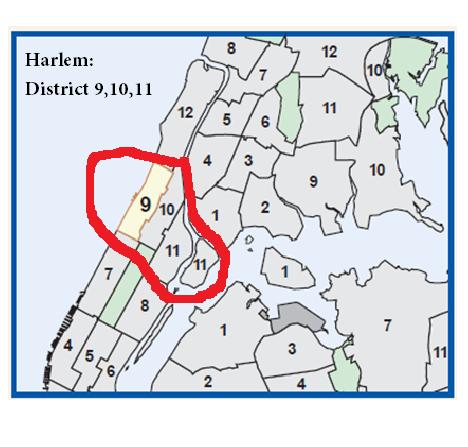
District 9:
http://www.nyc.gov/html/dcp/pdf/lucds/mn9profile.pdf
District 10:
http://www.nyc.gov/html/dcp/pdf/lucds/mn10profile.pdf
District 11:
http://www.nyc.gov/html/dcp/pdf/lucds/mn9profile.pdf
District 10:
http://www.nyc.gov/html/dcp/pdf/lucds/mn10profile.pdf
District 11:
http://www.nyc.gov/html/dcp/pdf/lucds/mn11profile.pdf
Subscribe to:
Posts (Atom)